Every Tuesday morning, before the streets of Port-au-Prince fully awaken, Samuel’s mother begins preparing for the journey to Kay Ste. Germaine Rehabilitation Center. She dresses her son carefully, checks his therapy bag, and helps him into the vehicle that will carry them through the city’s traffic and uncertainty. Outside, motorcycles weave through crowded streets, vendors prepare for another day of business, and the sounds of the city begin to rise with the morning heat.
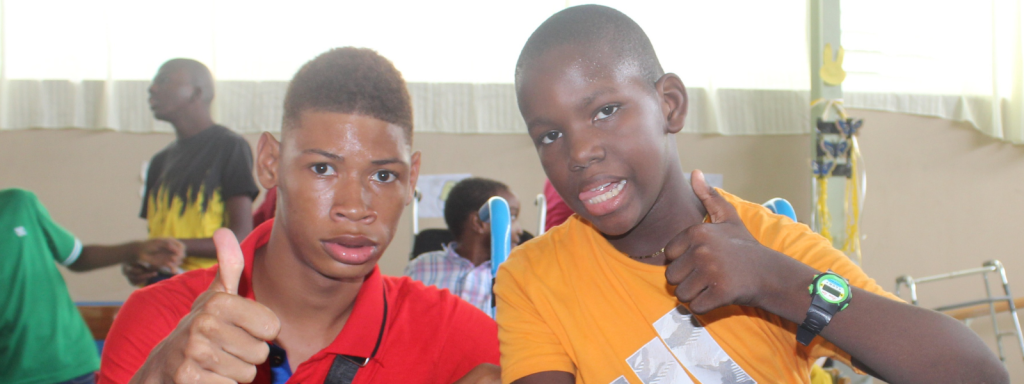
Inside the walls of Kay Ste. Germaine, another reality quietly unfolds — one built on patience, therapy, dignity, and hope. Samuel, an alias used to protect his identity, is ten years old. He loves football, video games, and laughing with his father. His smile arrives quickly and easily. So does his determination. When he enters the therapy room, he greets the staff enthusiastically. Brightly coloured mats cover the floor. Therapists kneel beside children encouraging each movement. Parents exchange quiet conversations while wheelchairs, walkers, and therapy equipment line the walls. The rooms are filled with concentration, encouragement, and the occasional burst of laughter.
For Samuel, this centre has become part of daily life. Following a premature birth, he was diagnosed with cerebral palsy affecting all four limbs. His parents were devastated when they first learned of the diagnosis. In the early months, they felt alone.
Living originally in northern Haiti, the family struggled to find specialised rehabilitation services for children with disabilities. Access to paediatric therapy in Haiti remains extremely limited, particularly for vulnerable families outside the capital. Eventually, relatives encouraged them to travel to Port-au-Prince, where they were referred to the Special Needs Programme of NPH Haiti at Kay Ste. Germaine Rehabilitation Center.
That decision changed everything. “I have never missed a therapy session,” Samuel’s mother explains. “Every improvement gives me more hope for my son’s future.” Over the years, she has watched him achieve milestones that once seemed impossible. Each new skill, however small, has strengthened her belief in what he can achieve.
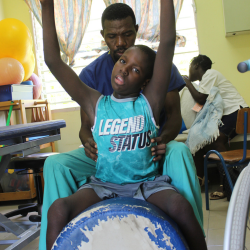
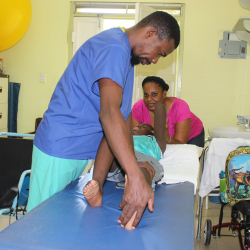
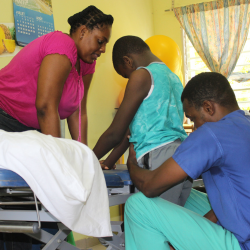
A Rehabilitation Center for Children with Disabilities in Haiti
Opened in 2008, Kay Ste. Germaine Rehabilitation Center became an important expansion of NPH Haiti’s disability and inclusion services. The centre provides specialised rehabilitation services for children and adults living with disabilities, neurological conditions, or post-trauma injuries. Services include physical therapy, speech and language therapy, neurological rehabilitation, developmental therapy, mobility assistance, and stroke recovery support. Today, Kay Ste. Germaine serves approximately 40 children per day with neurological disabilities while also supporting around 50 adult stroke patients every week.
For many families, the centre represents one of the few places in Haiti where consistent rehabilitation care remains accessible. The name itself carries symbolic meaning. “Kay” means “house” in Haitian Creole, while “Ste.” is the French abbreviation for Sainte. The centre takes its name from Sainte Germaine Cousin, a French saint born in 1579 who lived with illness and physical disability throughout her short life. Marginalised during childhood and raised in poverty, she became known for her compassion toward others despite her own suffering.
Though the rehabilitation programme is not directly connected to her story, the symbolism remains deeply relevant. Sainte Germaine became associated with care for the vulnerable, the poor, and people living with disabilities — values reflected daily within the centre that bears her name.
More than four centuries separate Samuel and Sainte Germaine. Yet both experienced lives shaped by physical challenges beyond their control. And both remind us of an important truth: a person’s value is never defined by disability. The mission of Kay Ste. Germaine reflects that belief every day, helping children discover abilities, confidence, and opportunities that might otherwise remain out of reach.
On June 15, her feast day, staff, families, and children at Kay Ste. Germaine reflect not only on the saint herself, but also on the broader mission of inclusion and dignity that continues guiding the programme today.
Learning Independence, One Step at a Time
When Samuel first arrived at Kay Ste. Germaine as a young child, even basic movements were difficult. He struggled to sit independently. Communication was limited. His parents feared for his future. But over nearly a decade of therapy and specialised education, Samuel has made extraordinary progress. Today, he can sit upright independently, feed himself, communicate verbally, and participate actively in classroom activities. He no longer requires diapers and continues working toward greater autonomy every day. At the centre’s special education school, Samuel learned to read and write despite the physical challenges affecting his coordination.
His teachers describe him as bright and determined. Writing remains physically challenging, but he continues trying every day. His favourite moments often happen outside structured therapy sessions. Between appointments, Samuel jokes with other children, watches football highlights on phones, or proudly demonstrates small achievements to therapists and visitors.
Inside Kay Ste. Germaine, progress is measured differently than in most places. A child standing for several seconds unassisted.
A first spoken sentence.
Holding a spoon independently.
Learning to write a name.
Moments that may appear small elsewhere become life-changing victories here.
Supporting Families Beyond Therapy
The work of Kay Ste. Germaine extends far beyond rehabilitation exercises.
In Haiti, families raising children with disabilities often face overwhelming social and economic pressures. Access to healthcare, therapy, transportation, medication, and inclusive education remains limited. Many parents stop working entirely in order to provide full-time care for their children.
Samuel’s mother made exactly that sacrifice.
She worried constantly about leaving her son in the care of others due to fears of mistreatment or neglect connected to his disability. Like many Haitian parents of children with special needs, she chose to dedicate herself fully to his care despite the financial consequences.
Kay Ste. Germaine helps reduce some of those pressures through family-centred disability support.
In addition to rehabilitation therapy, the programme may provide food assistance, hygiene supplies, medication support, mobility devices, emergency assistance, and occasional livelihood support.
These services are designed not only to improve quality of life, but also to reduce the risk of child abandonment and help children remain within their families and communities.
The centre also supports approximately 50 adult stroke patients each week through rehabilitation, therapy, meals, and social support. While Kay Ste. Germaine began with a strong focus on children, it has evolved into an important rehabilitation resource for the wider community.
Rehabilitation and Resilience in Haiti
The role of Kay Ste. Germaine expanded dramatically after Haiti’s devastating 2010 earthquake, when therapists began supporting survivors with traumatic injuries, amputations, and neurological trauma. What began primarily as a paediatric rehabilitation programme evolved into a wider community resource for both children and adults requiring long-term therapy, stroke recovery support, and mobility assistance.
Today, despite the ongoing challenges facing Haiti, families continue making the journey to the centre each day. Parents carry children into therapy rooms. Therapists guide exercises patiently. Teachers continue lessons. And children like Samuel continue learning, growing, and dreaming.
A Future Built on Hope
Samuel still dreams of one day walking independently. His mother dreams of seeing him continue his education and build a future where his disability does not define the limits of his life. Like many ten-year-olds, Samuel also dreams of football. Inside Kay Ste. Germaine Rehabilitation Center, those dreams are nurtured every single day. On June 15, the feast day of Sainte Germaine, staff, families, and children gather not simply to celebrate a saint, but to celebrate what the centre represents: dignity, inclusion, perseverance, and hope.
As another therapy session comes to an end, Samuel waves goodbye to his therapists before beginning the journey home. Next week he will return to practice new words, strengthen new muscles, and continue pursuing the dream he shares with his mother — greater independence and a future filled with possibility. That is what Kay Ste. Germaine represents. A centre where rehabilitation becomes dignity. Where therapy becomes belonging. Where vulnerability is met not with exclusion, but with compassion. And where every child is reminded that they matter.
Every therapy session, every mobility device, every meal, and every opportunity to learn helps children like Samuel build a more independent future. By supporting disability and rehabilitation services in Haiti, supporters help ensure that children living with disabilities receive not only care, but the opportunity to reach their full potential. Because every child deserves not only to survive, but to be seen, supported, and given the chance to thrive.