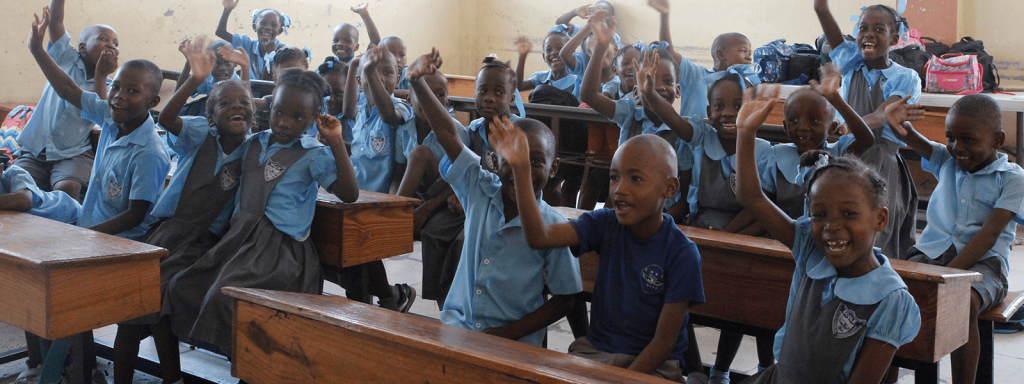
According to a report by the Union of Progressive Haitian Parents (UPEH) revealing data published in May 2025, 347 private schools and 51 public schools in the Port-au-Prince metropolitan area suspended operations during the 2024–2025 school year. Twelve faculties at the State University of Haiti and fifty private universities also closed their doors, forcing several thousand students to interrupt their studies.
In Haiti, continuing one’s education during adolescence has become a privilege that many can no longer afford. Behind the deserted classrooms, abandoned uniforms, and notebooks closed too soon, a brutal reality is taking shape: poverty, exacerbated by insecurity and the failures of the education system, is depriving an entire generation of its right to education, further fueling school dropout rates.
Every morning, thousands of Haitian teenagers wake up with the same question: will they be able to go back to school today?
The reasons for that are different. For some, the problem is financial. Tuition, transportation, uniforms, and school supplies represent expenses that are impossible for families already burdened by inflation and economic hardship to cover. For others, it is stray bullets, roads controlled by armed groups, or closed schools that make any continuity in schooling impossible.
Schools Closed, Futures Put on Hold
According to a report by the Union of Progressive Haitian Parents (UPEH), an organization that advocates for the right to education and regularly publishes reports on the Haitian school system. It is sounding the alarm about the impact of insecurity, warning of widespread school closures and administrative bottlenecks, revealing data published in May 2025, 347 private schools and 51 public schools in the Port-au-Prince metropolitan area suspended operations during the 2024–2025 school year. Twelve faculties at the State University of Haiti and fifty private universities also closed their doors, forcing several thousand students to interrupt their studies.
“This dual crisis, security and economic, has not only emptied the streets. It has put the future of an entire generation of young Haitians on hold,” reports Mackly Ford Cenor in Le Nouvelliste.
But poverty is not merely a lack of money. It creates an environment where every difficulty becomes yet another obstacle for children to overcome in order to continue their education.
The Double Burden Faced by Children with Learning Disabilities
Teenagers with learning disabilities are a striking example. Already facing educational challenges, they must also contend with prejudice and stigma. In cases where students are held back or drop out of school because they cannot succeed—since schools are not adapted to their needs—this leads to school dropout.
Ms. Dorcil, quoted by Le Nouvelliste, points out that these young people carry “a double burden”: that of their academic difficulties and that of the hurtful way they are viewed. Too often misunderstood, they are labeled as “incapable,” “retarded,” or “incompetent,” which accelerates their dropout.
Even when schools remain open, the quality of education remains precarious.
Journalist Marie Mite Duvergé, also writing in *Le Nouvelliste* a haitian journal, points out that repeated strikes by teachers, who have not been paid for months or are striking for other reasons, severely disrupt the continuity of education. These disruptions lead to academic delays, a loss of foundational skills, and a gradual decline in student motivation.
School then ceases to be a stable environment. For many teenagers, it becomes an interrupted, unpredictable, and discouraging journey.
Girls also pay a heavy price.
According to AyiboPost, citing analyses by Danièle Magloire, pregnancy remains one of the main factors leading to school dropout among Haitian teenage girls. In Beaumont, in the Grand’Anse department, 74 teenage girls became pregnant during the 2019–2020 academic year across eight schools, 44 of whom were minors. Some were the result of rape, or other cases of unwanted pregnancy. The figures from Beaumont do not even represent the entire country.
For many observers, the fight against school dropout rates inevitably involves the fight against poverty.
Because behind every statistic lies a story: that of a teenager forced to work to feed his family, of a young girl who drops out of school after an early pregnancy, of a student who cannot cross a neighborhood that has become too dangerous, or of a child with learning difficulties who stops believing in himself because he has been told time and again that he is “not capable.”
Education is often presented as the key to escaping poverty. In Haiti, the reality is harsher: all too often, it is poverty that decides who will be able to hold that key in their hands.
And when a teenager drops out of school, it is not just a student that the country loses. It is a dream cut short, a talent stifled, and a part of its collective future that crumbles.